- Home
- First 100 Years
- Part 3: Confluence of Transportation
- Chapter 1: Wabash & Erie Canal
Chapter 1: Wabash & Erie Canal
Before canals, transporting by wagon was difficult and slow. River routes random and disconnected, and both were costly. Canals arose as a more effective means of moving people and goods, thereby allowing settlements and markets to expand and grow.
The Wabash and Erie Canal opened through New Haven in 1843, forging a path through the wilderness. It was the longest Canal in the Western Hemisphere, traveling a distance of 468 miles from Toledo, Ohio at Lake Erie to Evansville, Indiana.
Using today's landmarks, the Canal made its way through New Haven southwest from I-469 at the old U.S. 24, through downtown and behind the houses on the north side of Main Street. At High Street, it turned northwest, went through Moser Park, and on to downtown Fort Wayne.
Of course, no man-made landmarks existed at the time; they arose because of the Canal which drew people and provided the means for economic vitality.
 The transport vehicle on the waterway was a canal boat, a long, low, narrow structure built for carrying passengers or freight. The boats were drawn by one to three horses or mules hitched to a long rope attached to the bow of the boat. They walked on a path, called the towpath, along the side of the canal and were driven by a man or boy who walked or rode.
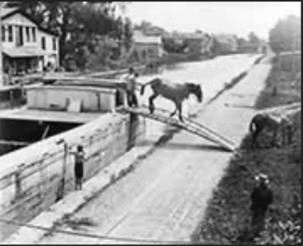 "Packet" boats spurred the growth of passenger travel across the region. They moved larger numbers of people more quickly, comfortably and at a lower cost than wagons. The boats had accommodations for eating and sleeping. After dinner in the main cabin, narrow beds were folded down like "hanging bookshelves".
The boats through New Haven made regular trips from Toledo to Lafayette, covering a distance of 242 miles in about 56 hours. They were pulled by one or two horses with fresh teams taken on every 15 to 20 miles. A pace of about 4-8 miles per hour was maintained.
Freight boats often carried a few passengers at a lower fare than packets. These were usually migrating settlers who bedded down on deck and found their own food at towns and farms along the way. Mules were used to propel freight boats and they were usually carried on board. The freighters ambled along at about 2 miles per hour with a cargo up to 80 tons or more.
The freight boats were key drivers of the growth that was experienced from the canal. They allowed consumer goods unseen before to be brought to the area from eastern markets. And they provided a means of getting bulk cargo such as grains, lumber, stone and barreled goods to distant markets.
This was especially beneficial to farmers and their families, allowing them to move from the subsistence farming necessary to support their families to market-oriented agriculture.
And the increasing flow of consumer goods available to them in town freed up time spent on subsistence activities such as making their own food, clothing, soap and shoes to focus on increasing the productivity of their land.
When the Canal was in its prime, a grain boat passed through town on the average of one every 10 minutes during a busy season. Oftentimes wagons waited their turns to unload the products of their farms bound for distant markets.
However, after about ten years of operation, it became increasingly clear to towns along the way that the Canal couldn’t be maintained in an economically sustainable way.
In the 1870s, a period of slow decline came for the Canal as towns along it began to shut down sections. In 1882, the section between Fort Wayne and New Haven was the last to be drained. [Photo: The remains of a Wabash and Erie Canal lock in Lagro, Indiana]
Many towns founded because of the Wabash and Erie Canal died with it. However, New Haven would never lose its busy air; what it lost from the decline of the Canal was more than restored by the railroads.