- Home
- First 100 Years
- Part 1: Where It Began
- Chapter 3: Maumee River Crossings Keep Pace with Progress
Chapter 3: Maumee River Crossings Keep Pace with Progress

As far back as is known, the local crossing of the Maumee River has remained virtually where it is today. Native Americans and animals, as well as the earliest pioneers, forded the river at this first crossing.
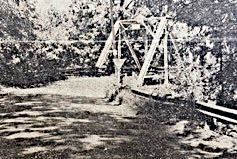
In the late 1850s, a covered bridge was constructed across the river to accommodate the increasing number of settlers and others traveling by wagons and horse and carriage. In heavy winds of December 1904, a portion of the bridge’s roof was torn away and sent down the river.
n 1912, that bridge was replaced by a towering steel structure on Rufus Street. That bridge also took a beating and was washed out in the epic 1913 flood—to this day, the most destructive flood to engulf the area.
This made a second steel bridge necessary and in 1913 a smaller Rufus Street bridge was built with a sharp curve that made access dangerous going north.
After serving the area for 53 years, the Rufus Street bridge was to be replaced by a concrete bridge. To accommodate the bridge, a new road was required to extend Broadway across the river. And to accommodate the new road, the house that stood at the end of Broadway was removed. [Photo: House in 1913]
 In 1966, four-lane Landin Road and its concrete bridge opened to accommodate heavy traffic.
In 2021, with about 10,000 vehicles per day traveling through the intersection at Landin Road/Broadway and Rose Avenue, Landin Road and the bridge underwent a reconstruction and renovation.
Deteriorating concrete was replaced and bicycle and pedestrian space as well as street lighting were added. The refreshed Landin Road and bridge opened to traffic in 2022.