- Home
- First 100 Years
- Part 1: Where It Began
- Chapter 2: Early Settlers Arrive to Establish Homesteads
Chapter 2: Early Settlers Arrive to Establish Homesteads
The first pioneers that came to the area, mostly by way of the Maumee River, found a landscape covered with dense, old-growth forests they had to clear before they could begin to build. Many trees were huge, measuring 90 feet to the first limb. The settlers came armed with only primitive tools and faced years of backbreaking labor.
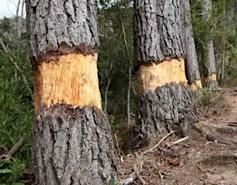 John Van Gundy was the first to arrive in 1820. He found a property that was high and dry between two creeks, and a short distance from the Native American and animal crossing on the Maumee River. Here Van Gundy “girdled” the trees with his ax, cutting through the bark layer causing the trees to die for later cutting. (This became known as “Gundy’s deadening.”)
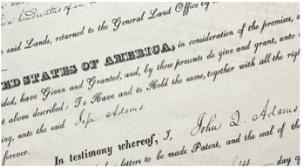 The earliest settlement of importance in the area was in 1823 when Jesse Adams, along with several other early pioneers, began to make their homes at “first deadening” and clear away the timbers. Adams, a prominent and respected businessman from Rochester, New York, bought 97 acres along the Maumee River.
In 1825, he received a land grant from President John Quincy Adams, the first deed to be issued from the Federal Land Office in Fort Wayne. The township was subsequently formed and named “Adams,” not in Jesse’s honor but in memory of President Adams. Jesse Adams, a man of many abilities, was named Squire of Adams Township. His farm was the first one in the township.
As the early settlers arrived to seek opportunity in the wilderness, they brought with them standards of life they left behind. They introduced Methodist church services in 1825 and opened a school in 1828. As others joined them, a tannery, a blacksmith and a mill were added, along with a post office and an inn called “The Hoosier Nest.”
The need for a cemetery arose in 1825 when Squire Jesse Adams’s daughter died and was buried on his farm. A second interment was made in 1828, and this location became the cemetery for the district. As the need increased, in 1830, the cemetery was moved due south to a larger piece of donated land. Finally, in 1875 the cemetery was moved to the current I.O.O.F. (Odd Fellows) Cemetery. Jesse Adams is buried in the cemetery along with other settlers of his day.