- Home
- First 100 Years
- Part 2: Origin As A "Canal Town"
- Chapter 6: "Canal Town" Matures into a "Transportation Town"
Chapter 6: "Canal Town" Matures into a "Transportation Town"
In 1882, the Wabash and Erie Canal was drained and the Nickel Plate Railroad joined the Wabash Railroad as the progressive means of transport through town. This began New Haven’s transformation from a “canal town” to a “transportation town.”
By 1920, 100 years of progress were evident since John Van Gundy first ventured into the territory, “deadened” trees in the wilderness, and set in place the beginning of New Haven. The town was now flourishing.
New Haven enjoyed a City Hall constructed in 1913 to house the town offices, jail and fire department, as well as an “opry house” on the second floor. (Still standing at 428 Broadway; rated as “outstanding” for its historic authenticity in Indiana’s architectural database)
The streets in 1920 were considered excellent. The town was well lighted, with electric current coming from Fort Wayne. Its water was rated excellent by state tests, while the waterworks plant maintained high water pressure to support the volunteer firemen’s association in case of fires. New Haven’s post office provided free delivery to five rural routes.[Photo: New Haven’s first fire truck]
Industry flourished as railroads offered far greater opportunity than the Canal for moving goods to distant markets. [Photo: Chair factory in New Haven]
Industries in New Haven circa 1920—100 years since “Gundy’s Deadening”
 The earliest industries to emerge in town in the mid-1800s were attracted by and located along the Wabash and Erie Canal. One of those businesses was still in operation in 1920. The Maumee Valley Flouring Mill, first opened in 1864, remained as one of the best-known mills in this part of the state. It had been purchased, rebuilt and modernized by Joseph Brudi & Co. following a deadly explosion in 1871. [Photo: flouring mill before being rebuilt]
 After the Canal was drained and the railroads became the modern mode of transport, new industries emerged along the railroad tracks. The influence of the area’s high-quality timber resources was evident with the opening of woodworking factories employing modern methods.
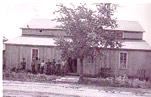 Two large handle factories conducted thriving businesses, Schnitker and Son and Sperry Manufacturing. These enterprises made wood handles for axes, hatchets, spades, and other tools.
 The New Haven Lumber and Supply Company had an extensive depot of all varieties of fine lumber for construction and inside work. It also manufactured doors, sash and other parts for building.
 The Elastic Plaster Company also catered to builders, offering, along with lumber, plaster and cement blocks.
Two grain elevators provided facilities for the township’s farmers to get their grain to market. The elevators were built to suit the loading and storage requirements of grains transported from farmland via the railroad. [Photo: Hiser and Minsel Grain Elevator]
Another grain-based business with an extensive plant was the Rice Cereal & Milling Company. Its stock was held largely by Adams township farmers and New Haven residents. [Illustration: Advertisement in Fort Wayne Daily News]
The stockyards of Kaufman and Company had a shipping capacity larger than that of Fort Wayne, sending a wide variety and quantity of locally bred stock to market to meet the demand of a growing nation.
An industry of special note not dependent on locating near the railroad tracks was the New Haven Floral Company on Bell Avenue between Henry and Eben Streets. Founded in 1912, the enterprise covered more than an acre. About 500,000 plants were potted each year. One thousand carnations were cut per day in season and all the rarest varieties of roses were cultivated, about 800 cut daily. Flowers were prepared for shipment in a cooling cellar; sales were principally wholesale to the trade.
 By 1920, several forms of personal transportation beyond horse and buggy had become available, affording people more convenience, broadened exposure and enhanced quality of life. These new opportunities were most evident on the south side of town.
In 1903, the Fort Wayne, Van Wert and Lima Traction Company’s interurban line began service through New Haven along today’s Lincoln Highway. The line had an attractive depot on the northwest corner at Broadway. [Photo: New Haven station and train]
In 1908, the automobile began to appear in New Haven with residents Mr. and Mrs. Ira Butler sporting the first Ford Model T.
The automobile took on added attractiveness when, in 1914, the Lincoln Highway was constructed through New Haven on its path between New York City and San Francisco as the first coast-to-coast highway.